Economic development is coming – but where is it going?
Without "shovel-ready" sites available in Walker County, there will be no place for new business to go. Part 1 of a roundtable discussion on economic development.

In 2007, the City of Huntsville looked to the future with a comprehensive plan called Plan 2025. Economic development, long emphasized by the city and county, was included in that plan, which listed eight specific goals falling into three categories: helping businesses thrive, workforce development, and creating a positive image and vibrant downtown.
Because the plan's target date was just last year, it provides an excellent springboard for a discussion about economic development. With the recent creation of the Walker County Economic Development Corporation (WCEDC), this topic is now front and center on the priority list for Walker County.
So on May 29, over a meal of papusas and rotisserie chicken, The Huntsvillan gathered four community leaders at the WCEDC office for an honest discussion about economic development in Walker County – the good, the bad, and the ugly. The discussion, moderated by Chief Humanist Mary-Brett Stringer, had four panelists:
Kaye Boehning, owner of Tomorrow's Promise Montessori Schools, which has expanded into two new locations since 2021 and employs almost 80 people
Darren Grant, longtime school advocate and economics professor at SHSU
Blake Irving, former Huntsville City Councilmember with a lot of municipal government experience
Stephanie Smith, WCEDC Director
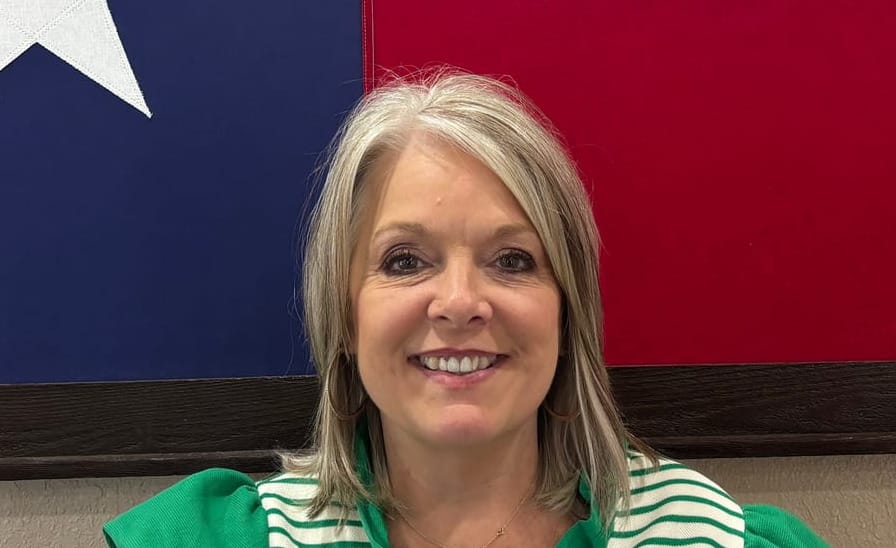
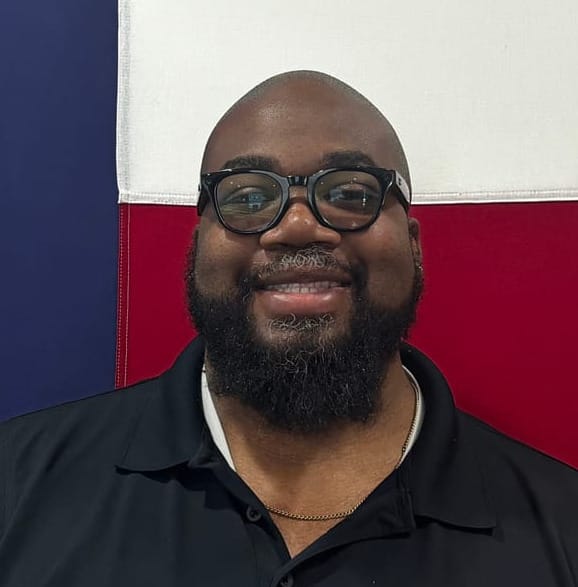
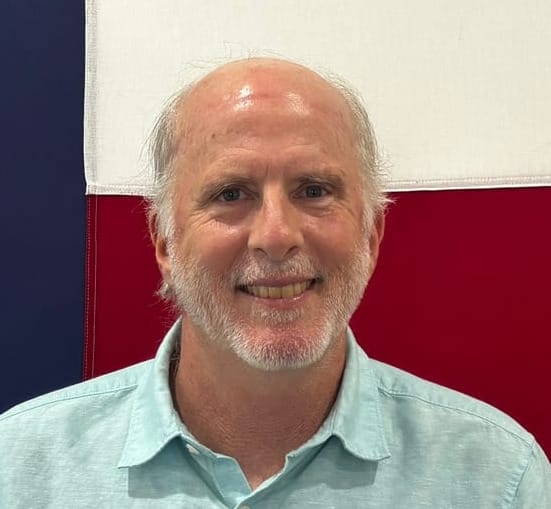
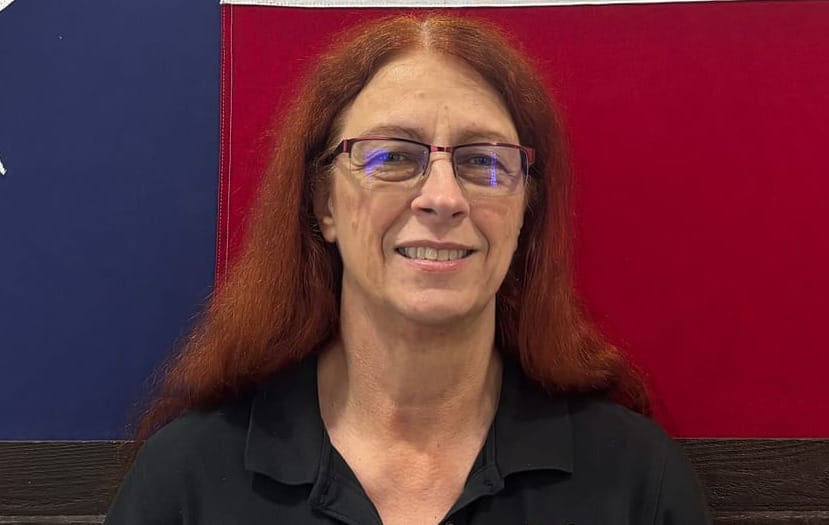
Clockwise from top left: Stephanie Smith, Blake Irving, Kaye Boehning, Darren Grant. Photo credits: Mary Brett Stringer.
Economic development is hard. Walker County is going up against many other places that have a head start on us. To compete, you need a winning strategy and good execution – something no one person can do alone.
The discussion will be presented in three parts, each edited for brevity and clarity. Today's segment covers the first category listed above: helping businesses thrive.
If you don't build it, they won't come
Mary Brett Stringer (MBS): So we're gonna start with you, Stephanie, and focus on helping businesses thrive. The two biggest things listed in Plan 2025 were housing availability and shovel-ready sites for businesses to locate. A lot of housing has been built since then, especially west of I-45, which has several new subdivisions and apartment complexes.
Shovel-ready sites is another matter, and Stephanie, I know you've talked about that a lot. How important is that to economic development, especially in this business climate?
Stephanie Smith (SS): Today it's more important than it was even 10 years ago, because of the speed to market now. I think there are like 29, 30 projects that we couldn't even submit for because we don't have the existing infrastructure on the ground to put those in.
Darren Grant (DG): Speed to market, I think you mean the business wants to come in and get up and running quickly – they don't have time to look around for sites and prep sites.
SS: Correct. I have seen some shovel-ready sites in this year. We opened our doors one year ago. We have two parks that are now online that are shovel-ready or proposed as industrial parks, business parks, that I've been able to respond to about five to seven Requests For Information for these two sites.
That is crucial for us. We need more shovel-ready.
DG: So, what you're saying is that from 2007 to 2025 those shovel-ready sites really weren't created, right? That we’re still more or less at ground zero.
SS: Yes. I think that's pretty accurate.
DG: And it's just been hard to do that in this town.
SS: So what I've done since being here is started conversations with developers and landowners to figure out where we can put some industrial and business parks. There has been a lot of positive feedback. It's just gonna take getting somebody to come in and work with us and invest with us.
But we need to be intentional, and we need to be deliberate about what we're gonna be putting in. We don't wanna just build for the sake of building. We want something that doesn't change the core of who we are in Walker County, but complements it.
Because the WCEDC is a membership-based organization, I don't have the sales tax that a lot of similar organizations have to invest back into economic development. So I've gotta get creative. Maybe develop a small pocket of land and then sell it and turn it back in and do the next pocket.
Give me 50,000 square feet, 100,000 square feet. Let's start somewhere and turn that money back around and develop the next pocket of land.
DG: This reflects the nature of Walker County, which is oriented toward keeping taxes down. You see that in city council races and county commission races. And what that means is, Stephanie, you come in and you don't have a little pot of gold to work with.
SS: I wish I did.
DG: The seed money that you have to work with is quite small, so you're forced into a situation where you have to take that seed money and grow it like you described, develop a site and then get a return on that investment.
Because you need more money to play ball with these larger employers. What you have to work with right now just isn't enough to get in that ballgame.
SS: It keeps our doors open and I just hired my first employee. Up until four weeks ago, it was just me doing economic development full time.
And it's not cheap to do effective economic development. You've got to be out in front of the site selectors. You've got to be at these conferences that promote the industry you're going after, marketing.
But we set this organization up from the ground. You had website design and accounting and IT and computers and all of these things. So, we're trying to run effectively and efficiently, but we have to set our priorities as our finances dictate right now.
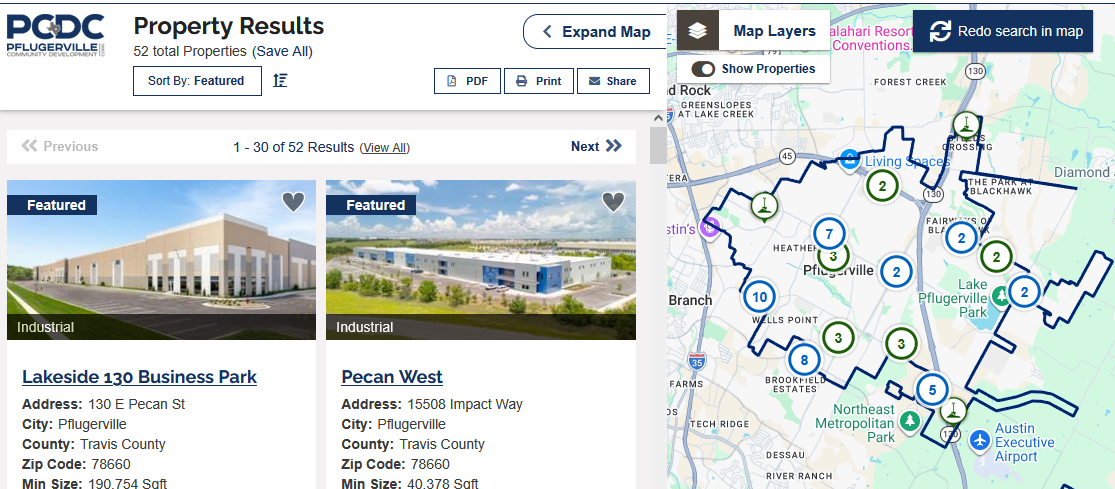
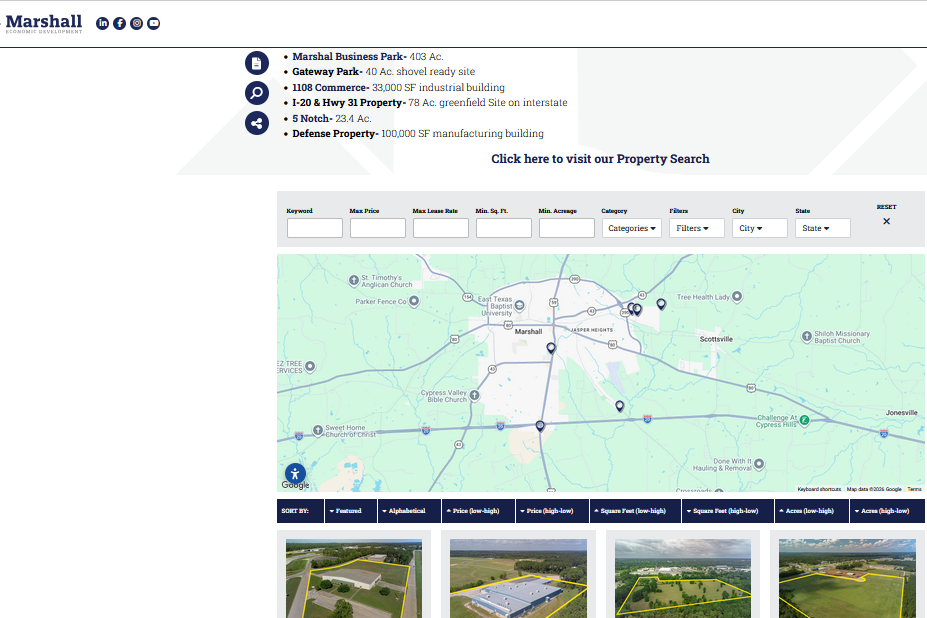
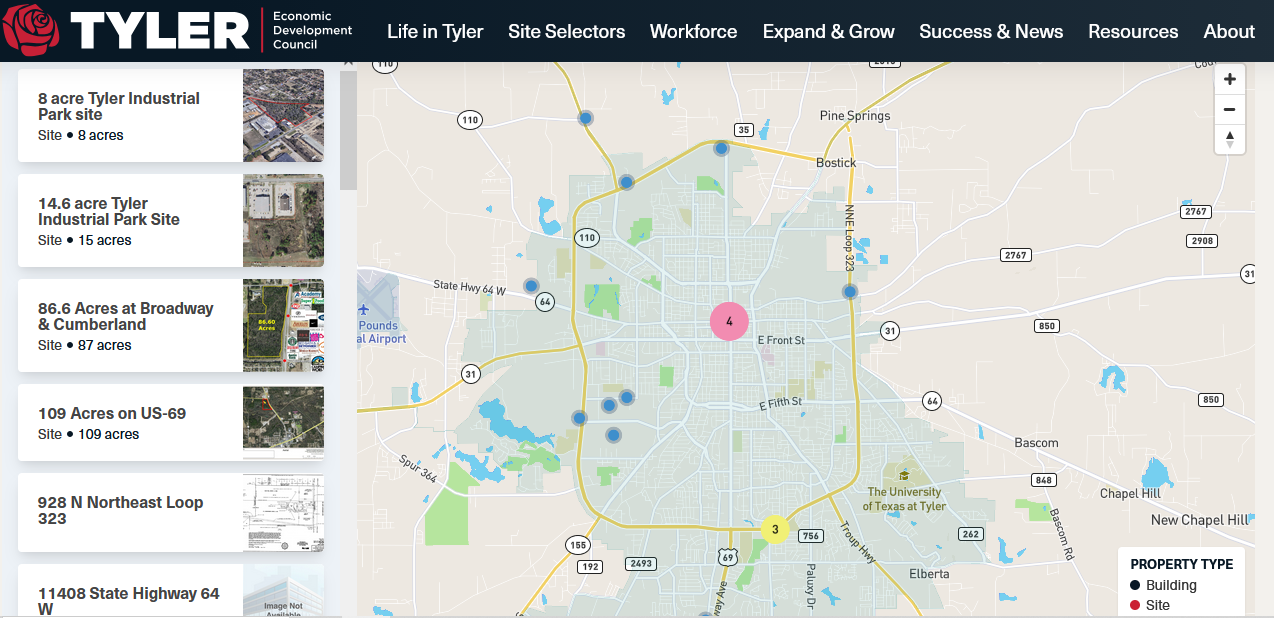
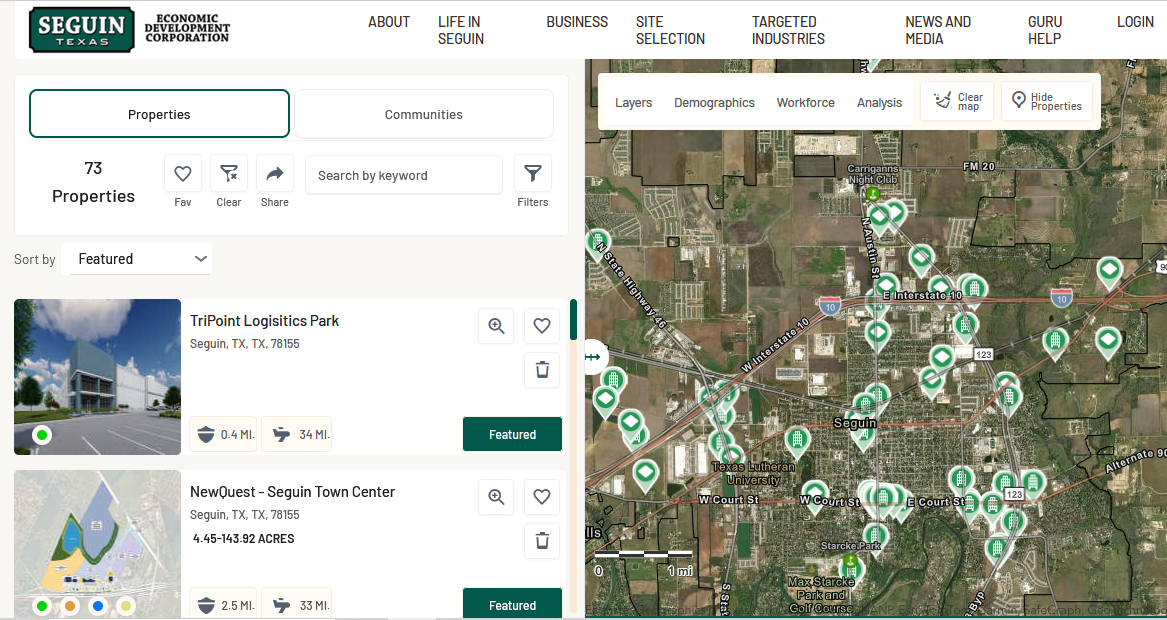
Many communities are loaded with shovel-ready sites. Clockwise from top left: site location maps of the economic development corporations (or equivalent) of Pflugerville, Marshall, Seguin, and Tyler.
MBS: What kind of businesses are you looking to bring in?
SS: Most of our projects are manufacturing projects. A lot of the larger projects that we're looking at are advanced manufacturing, aerospace manufacturing, biopharma manufacturing.
Before Covid, that wasn't the case. Everything was going offshore. With Covid, we've brought manufacturing back into the United States.
We're seeing a lot of foreign direct investment, and they want to come in, set shop up in an existing building with existing infrastructure, and be operational in six months. Our sweet spot, we have about 18 projects that we turned away that are looking for 100,000-500,000 square feet.
DG: Blake, you were on city council for a while, and this idea of having a space that new companies could come to, was that a big part of the discussion?
Blake Irving (BI): We talked about it but at that time at the management level they were not willing to take the risk of providing site-ready sites for manufacturing. At that time, there was a lot of talk about I-14 coming through. When we talk about that, I think of Amazon or FedEx, UPS.
Especially out on Hwy. 19, the east side of town, they have access to I-45, they got access to, I-14, Highway 30. They can go to Trinity. And there's lots of land out there that isn't developed, so why not go tackle that? But again, at that time, management just wasn't really willing to take that risk to do that.
In economic development, every week is infrastructure week
SS: Correct me if I'm wrong, Blake, I think there's not really– there's gotta be a collaboration between the city, the county, economic development, the utilities, to figure out where the best area is for this infrastructure to go in first.
I don't think there's been direction in that. So I applaud the city not going in and wasting a lot of money someplace that really might not have been a good place for projects. It's expensive to expand those water lines, sewer lines, build the roads, things like that. Let's now talk about where it is that we need to go, and those are the conversations I’ve had.
Kaye Boehning (KB): I will say the infrastructure has to be there. Because I just expanded a few years ago and bought the land. I was stupid. There was water, sewer, electricity across the street, so I assumed that it had electricity. It did not.
So, we went round and round for a while to get electricity to that site. Once my project got finished, it added to the value of that property and the city's getting more property tax money now. But it was a process to go through, and I have a friend that had a much bigger project and had problems getting water.
SS: Yeah. I think that has a lot to do with permitting and the processes in the city and the county. There have been conversations that we will work through. Because if I'm gonna bring companies in, we've got to be known as easy to do business with. And I don't know that that's been the perception.
DG: I'm in a position to speak more plainly. It is fair to say that the city's reputation for ease of doing business with has not been great in the past. I do think it's gotten better.
KB: Yes, it has.
DG: But it’s not starting from where it should have been.
KB: Having had projects and done things for 29 years of city and permits and things like that, it's improved.
SS: I think it's gotten a lot better. I know the appetite is there to make sure that we streamline processes, not just for new projects, but for existing development.
MBS: Is there something you can pinpoint as to why that's improved?
KB: For example, the first building that I used for Tomorrow's Promise, the existing electrical was fine.
Then when I expanded and bought another building, I had to pull all the electrical out and run conduit. My grandfather was an electrician. I knew you didn't need to do that because, I mean, I've done all these other buildings, and then when we got to that building, I was like, "You, I gotta do what?" But I had to meet the city code at the time.
But now, the last construction we've had, it was regular electricity. They went to a national standard, and it was a lot better than, "Oh, this person's in the office today, and this is the rule, and this person's in the office today, and this is the rule." A lot of that has been streamlined.
SS: I think the mentality has changed too. There is now a coordinated countywide economic development effort, and there's been a lot more conversations of how the county and the city of Huntsville wants to be perceived.
To be competitive, you've got to change some of those processes. So I think that coordination really kind of set that in motion.
MBS: What are we doing to make sure that we have the infrastructure to bring in these businesses, knowing that this is something that is a continuous problem?
SS: We'll continue to go after grant money because that will help in economic development infrastructure where it's not onerous on the taxpayers to have to come up with that.
And then try to get a project in here that will have a good capital investment and help with that infrastructure. 'Cause if you have a data center or private manufacturer come in, it brings that infrastructure to that particular site, and it benefits all of those along that line.
MBS: So you brought it up...
[group laughter]
MBS: Data centers.
SS: I think everybody wants to know about this.
Yes, I want a data center. No, I don't want multiple data centers. Data centers are low job counts but they bring a lot of capital investment. They will allow us to bring in infrastructure that a smaller project wouldn't allow us to do.
There are I know a lot of environmental issues around data centers. They are processing a lot cleaner, a lot more technology savvy. So we gotta find the right fit, I'm not just gonna go after any and every data center.
I don't wanna use up our water. I don't wanna use up our electricity. I want to make sure that we're smart about what we attract. And we have had conversations, and Entergy has had conversations with data centers, and so we'll continue those conversations. If it fits, it fits. If it doesn't, then we'll move on down the road.
KB: The city, they passed a tax to upgrade the water system and things like that. As a taxpayer, everybody complains about having to pay some more in taxes. But I had a property I was gonna sell, and they wanted to put apartments, 16 units or something like that.
Well, the sewer system wasn't capable of handling what they were wanting to do, and it's in the process of being upgraded for 2030. Well, they didn't want to wait that long to develop, so I still own that land.
So the city is making progress on updating some things, and then there's other things, it just takes a while.
Turns out, businesses need customers
MBS: The last thing we wanna touch on helping businesses thrive is getting them started to begin with. Entrepreneurship. SHSU tried a business accelerator about 10 years back, and it went nowhere. What should we do to support entrepreneurs more?
SS: There's no reason for us not to be entrepreneurial savvy or tech savvy. We've got Sam Houston State University right here. We are having conversations with entities that have the entrepreneurial spirit, kind of the co-workspace, incubator-type situations. We've just gotta get the right people at the table.
KB: We also have Sam Houston's Small Business Development Center. They've helped, like, between 40 and 63 new startup businesses in the past year. I mean, I was one of those 29 years ago.
MBS: Just this morning on Facebook in one of the groups, where we need a teen center, and there was over 100 comments of, "It's not gonna work because Huntsville doesn't support Huntsville businesses."
What do we do about that? Because if we're trying to make it an entrepreneurial place, but nobody's supporting our local entrepreneurs, what's that disconnect?
KB: I mean, you have your employee turnover, you have how much you can pay somebody, because you've gotta keep the costs low in order for people to afford to come because we are in some ways a lower economic community.
I mean, look at our movie theater. People complain about it not being theater seats like you can get in Conroe, but they don't wanna pay-
MBS: It's only $6.
[group laughter]
KB: So our movie theater charged $3 for the longest time and felt bad when they raised the rates to $5. But if they were to remodel and charge $15 a movie, you would not see the support.
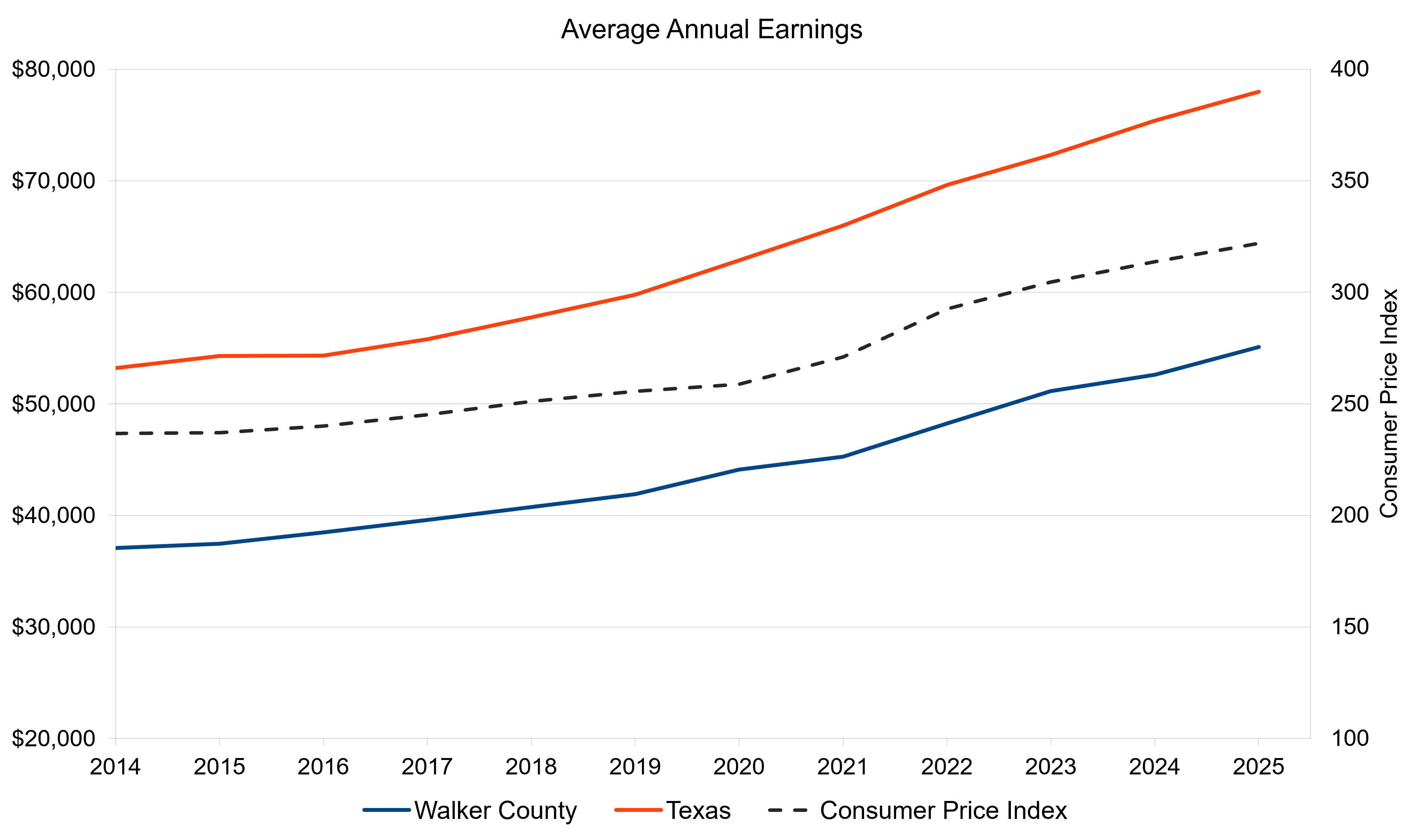
DG: What you're saying, Kaye, is ultimately the best support for a business is a customer base. Huntsville is not a high income town, and that naturally limits the support businesses get in terms of customers coming in the door.
KB: You can't have a Dave & Buster's here because it's expensive. Nobody's gonna go to a Dave & Buster's here, and it is gonna close down. So nobody in their right mind would put a Dave & Buster's here. There's just not the population for that.
DG: But they will go on Facebook and say they'd love to have a Dave & Buster's.
BI: So actually that was my cousin that posted that post.
I've thought about, when I was a kid, we had a skating rink and the old Dodge dealership would be a perfect place to do a skating rink, but at the same time, I don't want to go through that process of getting a loan, converting that space.
MBS: Right.
BI: And then I've gotta pay people a decent wage. What does that look like? How many people can I actually afford to hire? Those are all the things that come to my mind. So when I saw her post about it, I wanted to chime in, but there's parts that people aren't gonna fully understand.
Can you survive through the summer when the college is out? How many times are you really gonna take your kid skating?
SS: And that's the whole basis of why we're here, to bring in industry that has higher paying salaries so spouses don't have to commute outside of Walker County for good paying jobs.
It brings families back to Walker County because now both parents are working here and can afford to go to a Dave & Buster's, keep these businesses open.
MBS: I'm sure a lot of different things can be done. And that takes us to our next topic, about having jobs where people would stay and have the money to partake in bigger name establishments, workforce development. Stay tuned...
The second installment of this roundtable, focusing on workforce development, is here. The third and final installment, on Huntsville's image and downtown, is here.