Not messing around
Make no mistake. The new superintendent's leadership philosophy can only result in big changes to how Huntsville ISD does business.
For the Huntsville Independent School District, the worst of it began in 2010 and continued for years. Low and declining test scores, poor school ratings, high turnover of staff and administration, public discontent.
Somewhere in the middle of that period, perhaps 2014, the Chamber of Commerce created a committee called Promoting Our Positives, which provides support to the district's schools. It is still in operation today.
But that wasn't its only function. The name "Promoting Our Positives" serves another purpose. Emphasizing the positive meant disregarding the negative.
This was widespread within the district. One could attend meeting after meeting of the school board and never guess that Huntsville ISD was a seriously troubled school district. Only one person was shouting from the rooftops about the gravity of the problems within the district and the need to face them directly.
This omerta more or less continued under recently-departed superintendent Scott Sheppard. His monthly "Superintendent Briefing" at school board meetings, for example, never touched on the district's issues.
There is no clearer way to show you pose no threat to the system. Sheppard did have some important accomplishments, including passing a major bond proposal and improving the quality of school leadership. But if you aren't going to take on the system, there is only so much you can get done.
Last spring, however, the district's tone began to change. Could it be that its new superintendent, Travis Fanning, would want to face the district's problems head on? Two community forums held over the past week provide the answer: yes.
Let's chat
These forums were held last Friday morning at the old Scott Johnson Elementary School (before it moved down the street), and on Monday evening at the Performing Arts Center on the Huntsville High campus. Each lasted a little over an hour.
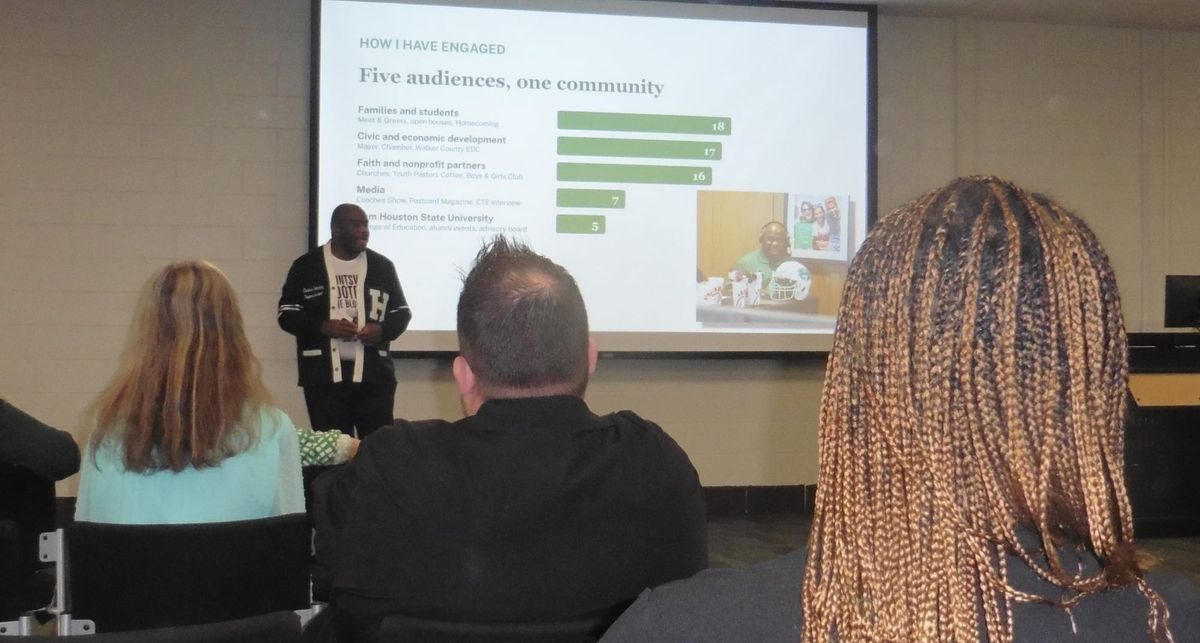
They began with an introductory presentation by Fanning. It first reviewed his efforts to get to know the district and community, going so far as to chart his interactions with different audiences – families, nonprofits, media, etc.
Most telling here was "Facetime with Fanning." Anyone working in the district can get a ten-minute one-on-one with the superintendent to discuss whatever is on their mind. He's had 92 of these so far, which means that more than 10% of HISD employees have taken Fanning up on his offer.
Then he talked about the road ahead. It's not a matter of figuring out what works so much as execution, he said. The district needs to be "holding adults and students accountable," with clear expectations and progress checks, so commitments become actions.
Then it was time for questions. The most common topic by far was behavior and discipline, comprising nearly half of the questions asked. Some were alarming, such as those about kindergartners in distress from classmates who hit them and threw desks. The remainder covered a smattering of topics, from economic disadvantage to computer use to parent involvement.
* College bound: over the past decade, Huntsville High graduates have been attending college less and less frequently
* Local schools get grades of their own: a breakdown of the 2025-2026 accountability ratings
* HISD staffing issues reach crisis levels: the number of uncertified teachers in the district is really high
Ways of thinking
These forums provided three important insights into Fanning's thinking. All three underscore his determination to take on the system that he now leads.
First among those is frankness. Throughout, Fanning plainly stated the district's challenges, in staffing, student attendance, and academics generally. One small detail highlights his commitment to being forthright.
In the Friday forum, a parent asked about her child having uncertified teachers. Fanning acknowledged that "we have a significant amount of teachers who are here who are not certified teachers." With fewer college students going into teaching at SHSU and across the state, he said, the district has to adapt.
In the subsequent forum, on Monday, no one asked about this problem – because they didn't have to. Fanning mentioned it right up front in his introductory presentation: "one of our challenges... is having [uncertified] educators." The code of silence has been broken.
For Fanning to be forthright, he must he know what's going on. This is his second quality: a desire to gather knowledge top to bottom. He understands that the people doing the work often know best what is going on. That is the purpose of Facetime with Fanning.
He knows he can learn from parents and community members too – thus the forums, which are unprecedented in recent experience. As Fanning said, their purpose "is to make sure I keep my eyes and ears to the street." You don't do this unless you really want to fix things.
A third clue to Fanning's thinking came in his responses to questions. You don't become superintendent unless you are well-spoken, and Fanning certainly is. Nonetheless, a couple of questions rattled him, and this was telling.
These weren't about the kindergartners. It's heartbreaking to hear of kindergartners crying about having to go to school, but Fanning was unfazed by this. This isn't his first rodeo and, unfortunately, he's probably heard this kind of thing before.
No, what rattled him was the question about uncertified teachers, and another question about the level of punitive discipline (such as suspension) in the district. These aren't classroom-level issues, but systems-level issues. This is where Fanning's thoughts reside.
This is probably as it should be. Dwight Eisenhower wasn't asked to empathize with individual soldiers, but to plan the invasion of Normandy. Similarly, a superintendent's job is to make the system work. That he so clearly thinks in these terms is a positive sign.
HISD administrative staff, also in attendance at these forums, probably know all this. They may not be happy about it. They didn't appear overly happy at these forums. But they and all district staff may need to adjust, because the tolerance for non-performance in Huntsville ISD just got a lot thinner.
The road ahead
Fanning's approach to leadership, unlike Sheppard's, is high-risk. The amount of change he wants to deliver is bound to make people unhappy, both inside and outside the school system.
At the same time, it is refreshing to see someone finally willing to tackle the district's issues head-on. An entire generation of students has graduated from HISD since 2010, many of them served less well than they deserved to be.
The district's problems are legion. Declining enrollment. High staff turnover, leading to many inexperienced, uncertified teachers. Endemic discipline issues. Low expectations in too many classrooms, and difficulty preparing kids for college. HISD has been troubled for so long that unproductive practices have become habitual, turning solvable problems into deep-rooted pathologies. This is what Fanning is taking on.
Which is where the public comes in. Turnout this past week was modest – under one hundred parents and community members for the two forums combined, fewer than half of them parents of schoolchildren. Fanning himself desperately wants to increase parent involvement.
And for good reason. To succeed in the change he hopes to bring to the district, to weather the inevitable blowback that will occur, he will need community support. Complaining about problems is easy. Doing something about them is hard. Fanning already knows that. The rest of us need to understand it too.
This article was composed by The Huntsvillan's Peregrination Correspondent, Darren Grant, who has followed our local schools for well over a decade. His TED talk on the benefits of bicycling for children can be seen here.