College bound?
Over the past decade, Huntsville High graduates have been attending college less and less frequently.

After Pomp and Circumstance, after the cards and gifts and the parties, a question looms for every high school graduate: What's next?
For some it's a job, for others the military. But the most common next step is more school. Nationwide and in Texas, 5 of every 8 high school graduates enroll in college, some in community colleges like Lone Star College, most in four year institutions like Sam Houston State University.
At Huntsville High School, the picture has become quite a bit different. College attendance has been on a ten year slide, with far fewer than half of recent graduates going to college in the following year. In return, career readiness is on the rise.
Slip sliding away
The state tracks every public high school graduate that enrolls in higher education in Texas. Almost half do so, with others going out of state.
In the late 2000s, Huntsville High School was in that same ballpark, sending just over half of its graduates to college in Texas. Sam Houston State University was, not surprisingly, the most common destination, with Lone Star College the runner-up. Altogether, 1/3 of graduates went to four year universities, with another 1/6 going to community college.
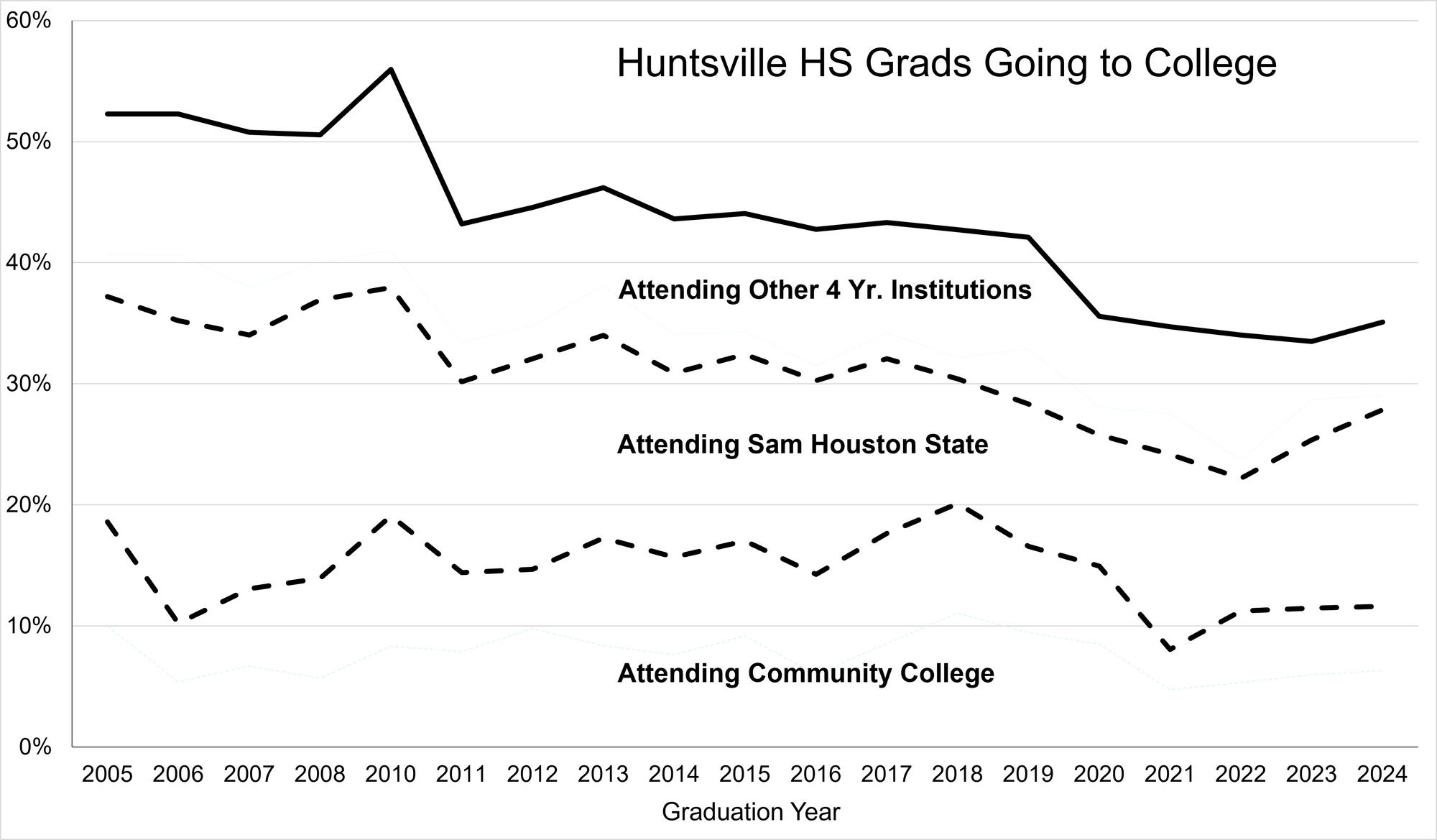
In the following decade, the community college numbers remained stable, but the numbers attending SHSU and other four year institutions began to slip, and Covid didn't help matters. Recently, only about 1/3 of Huntsville High graduates attend college in Texas the following year.
The slippage has been greatest for our state's flagship universities – the University of Texas and Texas A&M University. Through 2014, it was common for Huntsville High to send a total of 20 students to those schools each year. Since then, the average is closer to 15, with fewer than ten from the Class of 2024.
This isn't because they couldn't get in. Roughly 40 HHS graduates receive automatic admission to one or both universities each year. They are choosing not to go.
In recent years, college enrollment has, in fact, tapered off somewhat across the country. But the decline at HHS is faster. Its rate of college attendance resembled the state average during the late 2000s, but is well below that today. Something else is going on.
Fewer attendees mean fewer graduates
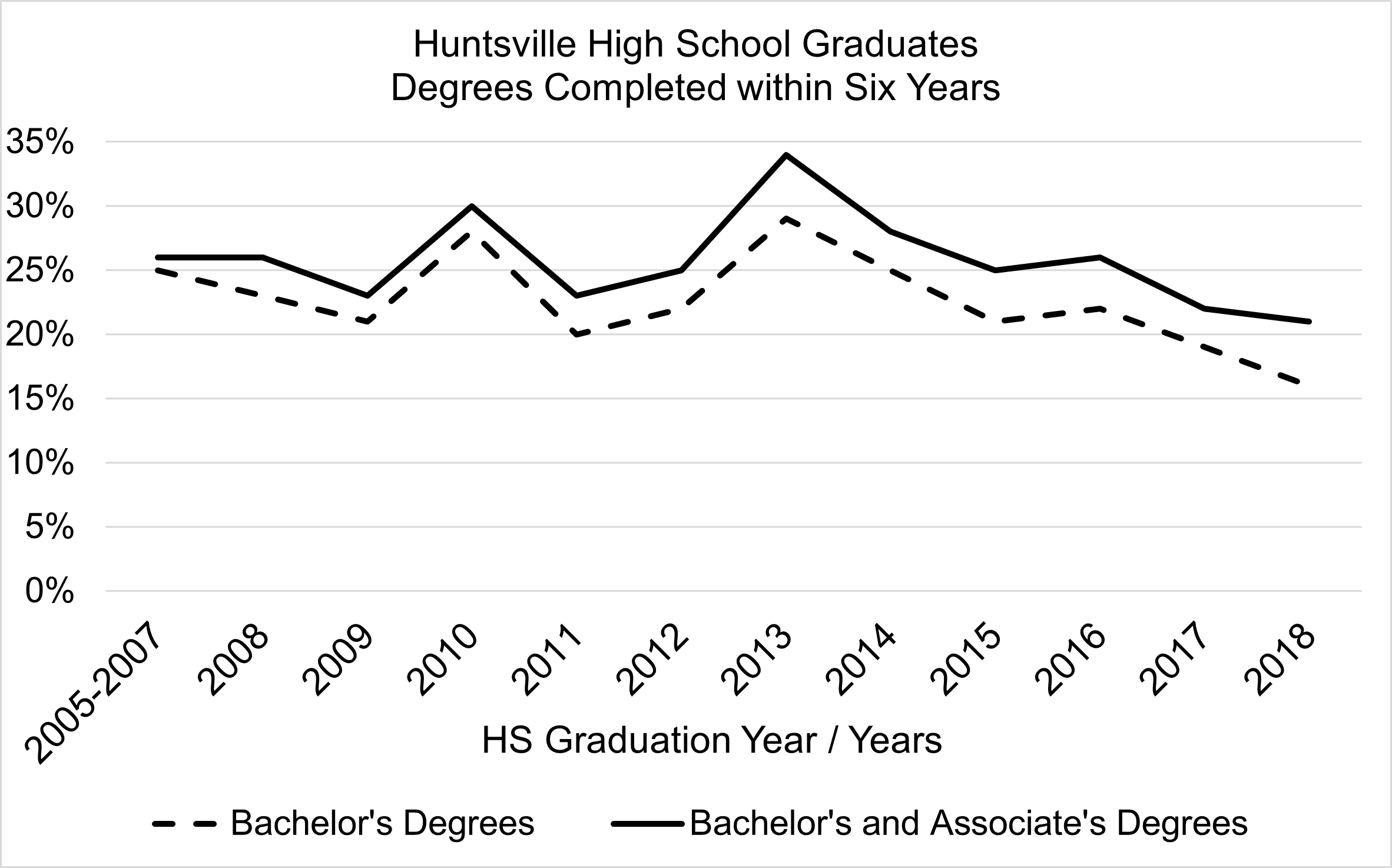
With fewer people going to college, there are also fewer people graduating. The timing here is broadly similar. Until 2016, about 25% of HHS graduates received a bachelor's or associate's degree somewhere in Texas. Since then, that fraction is down to about 20%.
The type of degree obtained has changed as well. There are more associate's degrees, which are typically completed in one or two years, but many fewer bachelor's degrees. There has been a movement toward the shorter degree.
While college education sometimes gets a bad rap, it still pays off. According to the federal government, workers in their late 20s and early 30s with a bachelor's degree earn $17,000 more than workers with an associate's and $25,000 more than high school graduates each year.
They're ready – for something else
One clue to what is happening comes from the Texas Academic Performance Report that the state puts out each year on each school. It identifies those seniors deemed "college ready," based on course credit and standardized test scores, and reports those percentages for each school and for the state.
Beginning with the 2014-2015 school year, these numbers dropped significantly at HHS and have never really recovered. That was the inaugural year of HISD superintendent Howell Wright, whose attempt to "reinvent education" in the district was ill-fated. At HHS, fewer students are going to college because fewer students are ready.
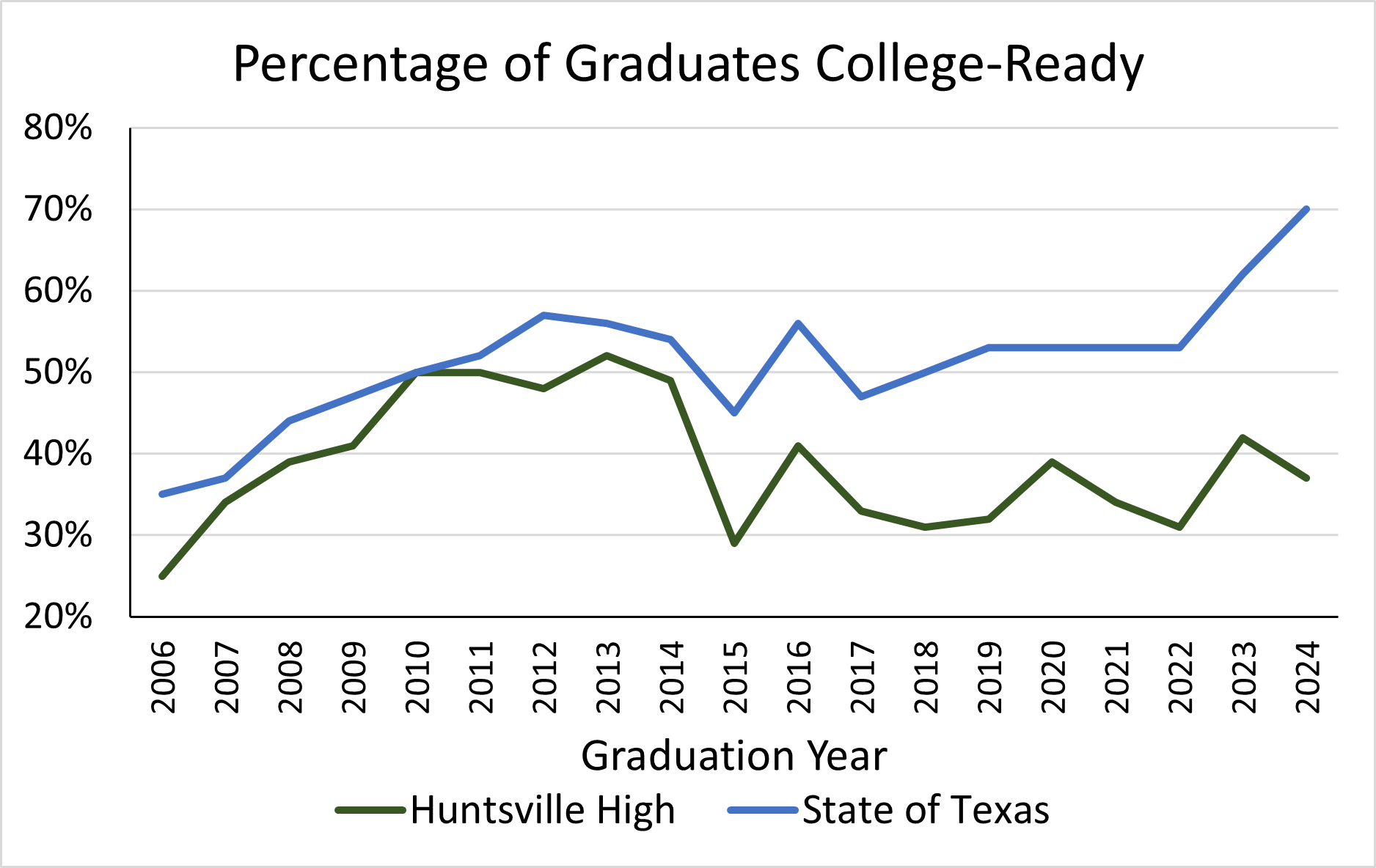
To a significant degree, however, this is by choice. Career preparation is up significantly at Huntsville High.
Matthew Lahey, Executive Director of Community Engagement for the school district, said that "post-secondary pathways have evolved significantly over the past two decades... Texas schools have increased emphasis on workforce certifications, dual credit opportunities, military readiness, and career and technical education programs alongside traditional four year college pathways."
Accordingly, the Huntsville ISD "has intentionally focused on expanding opportunities for students through [a variety of efforts] designed to help students prepare for success after graduation – whether that path includes college, workforce training, military service, or industry certification programs."
The signs of this are very clear. Beginning in 2017, the state began tracking industry-based certifications obtained by high school students. Since then, the number of those obtained at Huntsville High has absolutely shot up. In recent years, over half of graduates have such a certification. Accordingly, the fraction of Huntsville High grads deemed "career ready" by the state far exceeds the state average.
So again, the glass is half empty – but also half full. College preparation and college attendance are indeed down at Huntsville High School. But, to some degree, this has resulted from the district's significant efforts to expand opportunities for students who are less academically inclined.