Half Empty
While asking for tax money to expand last year, Huntsville Memorial Hospital was hemorrhaging patients.
The government. You have to tell it everything. That way it knows half as much about you as Google and Facebook do.
But even the government has its days, when the information it collects slices through the he-said/she-said and cuts to the chase.
For Huntsville Memorial Hospital, that day is today. Throughout 2025, its CEO, Patrick Shannon, made the rounds arguing for a major expansion, supported by tax dollars. But the data reported by the hospital itself – to state government, the IRS, and Medicare – indicate not a place beset by overcrowding, but something else entirely.
Pitching the hospital bond
In 2025, the Walker County Hospital District put proposals on the May and November ballots, asking voters to back $200 million in bonds to build a large addition onto the current hospital.
The pitch? The hospital is cramped for space and Walker County is growing. The time to act is now.
For example, in this bond discussion last October between Shannon and Rob Hipp of Hello Huntsville, Shannon says:
"You know, like I was saying today... a lot of times we'll have eighty-something patients in a bed in the hospital. And so we are many times full which backs up the emergency room which causes the delays in the ER. So we have to address that and increase our capacity."
Similarly, the hospital's information sheet on the spring bond proposal said, "the current facility is very busy."
This, paired with the expectation of future growth in our area, left an unmistakable message: the hospital is crowded now, and the problem will worsen in the future.
But if you listened carefully, not everyone was on the exact same page. Dr. Lane Aiena, then on the Hospital District Board of Managers, made a different argument for the bond: construction costs. "Construction's going up, it's way more per square feet to build medical facilities," he said. "If we were to put this off further, more expensive bonds are coming."
He then went off script:
"When it comes right down to it, about 70% of Walker and the surrounding counties go [to competing hospitals] down south. This hospital [HMH] closes, the other 30% goes down south as well. So why would they spend money to open up bricks and mortar, hospital of their own in our area, when they can just wait it out?"
Um – what? Closing? Why would you close? You're supposed to be crowded! But Aiena was onto something.
They're losing patients
Hospitals provide "inpatient" and "outpatient" services. If you get that colonoscopy and go home afterwards, that's outpatient. If you check into a room, that's inpatient. The proposed expansion would have added almost twenty "free world" beds and others for inmates, increasing the hospital's inpatient capacity.
Two key measures of inpatient use are the total number of admissions per year and the "average daily census," that is, the average number of beds filled per day. Both have been declining at HMH for several years, with the most recent, July 2024 - June 2025 reporting period being the lowest of all.
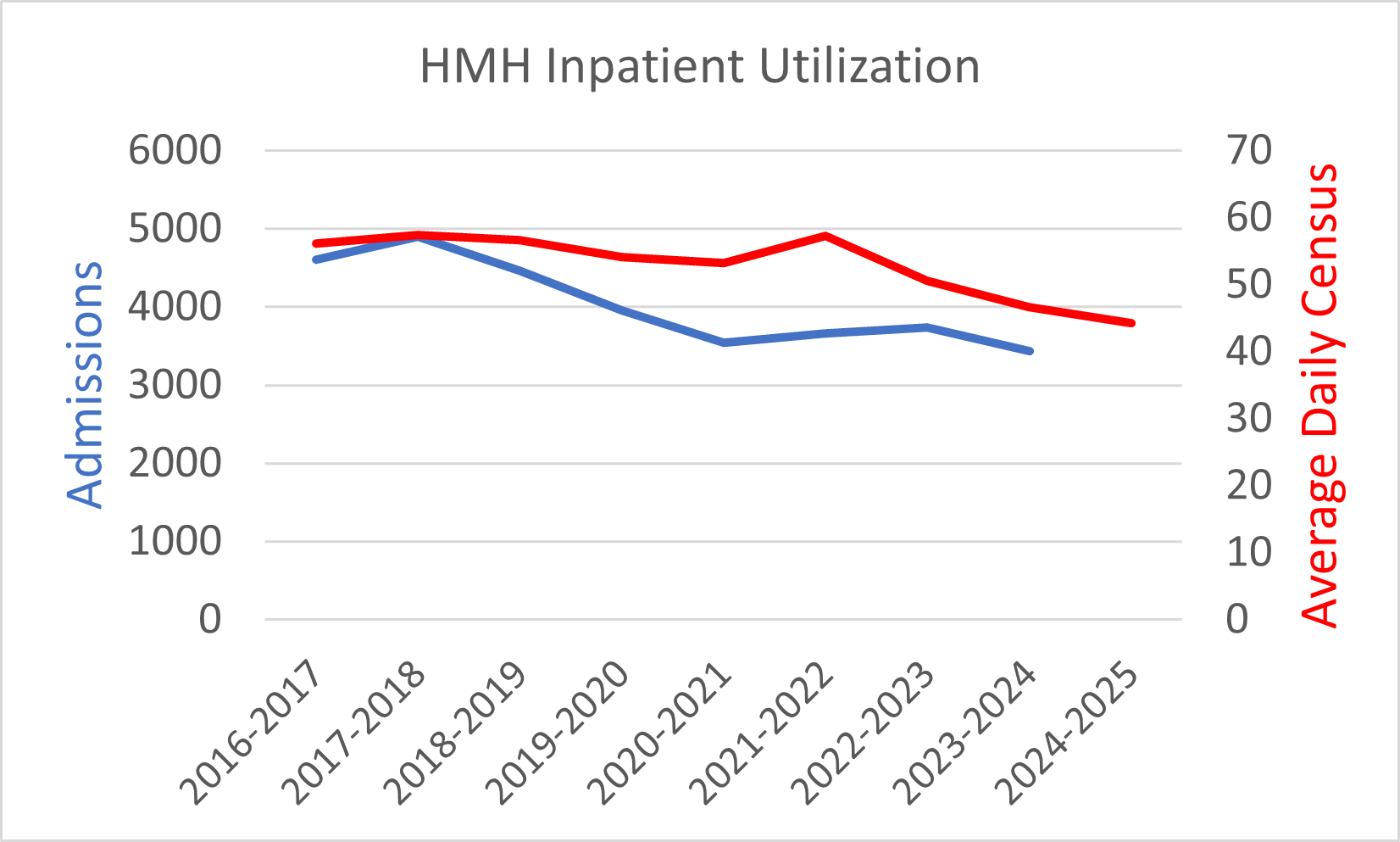
In that period, the average daily census of 44.3 was 52% of the 86 beds in the hospital. In a sense, HMH was barely half full. For comparable nearby hospitals, that number is closer to 60%. (It rarely gets too much higher, since you build for the sickest times, which are rare.)
Looking at revenues, you can go back even further. The cleanest comparison is to 2010-2013, before the hospital gained and shed ancillary facilities and ran into all kinds of problems. Back then, revenues were about 25% higher than now, adjusting for inflation. However you slice it, HMH's numbers are down.
Were the elected Managers of the Hospital District aware of these trends when they voted to put those bonds on the ballot? One can't know for sure. HMH administration makes a verbal report at each Hospital District meeting, but different statistics are mentioned each month, making it hard to detect trends. The Hospital District confirmed that Managers receive no written reports from the hospital. Last year's Managers were invited to comment for this story, but not given much time in which to do so. None did.
Drive south
One clue to HMH's issues comes from quality measures provided by the private sector and – you guessed it – the government.
The federal government generates an annual "Total Performance Score" and "Patient Experience Rating" for most hospitals, while the private sector Leapfrog Group gives them a semi-annual A-F grade. Together, these measures reflect patient satisfaction, process quality, and the frequency of "adverse events."
Across all three measures, HMH is fairly similar to other Deep East Texas hospitals – in Nacogdoches, Palestine, or Lufkin – which all tend to score near the national average.
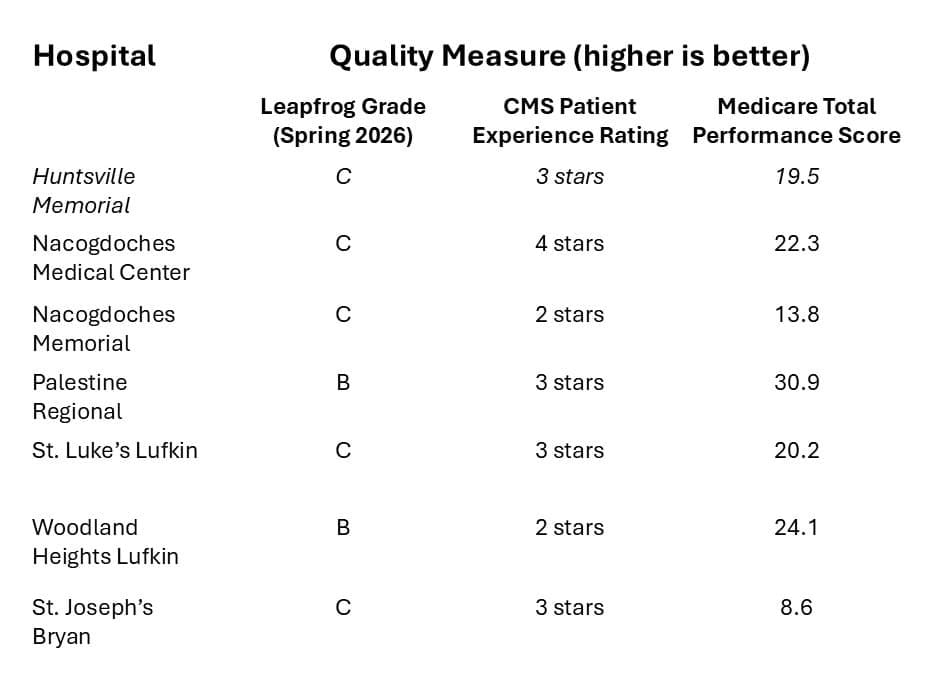
But Huntsville Memorial isn't competing with those hospitals. It is competing with the big boys in The Woodlands – Memorial Hermann, Houston Methodist, St. Luke's. That is what Aiena meant about patients driving south.
These hospitals are two to five times larger than HMH, giving them a cost advantage and expanding the range of services they can provide. And they're in that sweet spot of suburbia where all the doctors and nurses want to live, surrounded by wealthy, educated patrons with high expectations. And it shows:
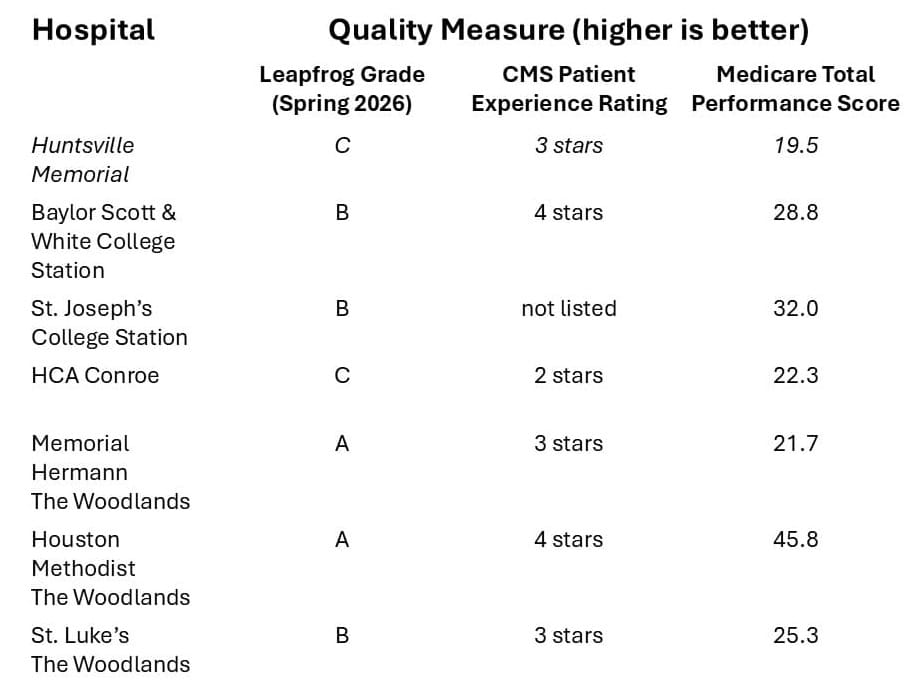
The Woodlands' hospitals surpass HMH on every quality measure (as do those in similarly wealthy College Station). With all those advantages, how could they not? This is why 70% of Walker County drives south. Our hospital's loss is local residents' gain.
Where to go from here?
You're a beagle, and a pretty good one. It's not your fault that, at chow time, the other dogs in the house are all Dobermans. Your job isn't to be a Doberman too – just the best beagle that you can.
At HMH, that effort is now led by Terry Scoggin, who replaced Patrick Shannon as CEO earlier this year. Scoggin acknowledges the decline in inpatient numbers but notes that those numbers don't tell you everything. A broader measure of utilization that incorporates "outpatient beds" rose in the last fiscal year. On the other hand, emergency room visits remain down significantly from pre-Covid levels.
The cup may be half empty, but it's also half full – and growing. Scoggin says "we are continuing to see growth in the current fiscal year," with many utilization measures up 5% or more. With the bond battle behind it, HMH can now focus on being the best beagle that it can. It has already made progress, adding two obstetrics-trained physicians in recent months, with another surgeon on the way.
The late Ivo Nelson pointed out last year that the central question isn't “When do we get a hospital?” but “How do we improve the health of Walker County citizens?” No one, pro-bond or anti-bond, denies that Huntsville Memorial Hospital will be a key part of that effort – and that it can't do it alone. This question is important enough that The Huntsvillan will return to it later this year.