Walker County's Congressional primary candidates lit $10 million on fire
The candidates had money to burn -- and did.
Does money vote? Of course not. It doesn't have proper ID. George Washington and Abe Lincoln can't even drive – how would they have licenses? Diana McRae and her team of election workers would turn them away from the polls so fast.
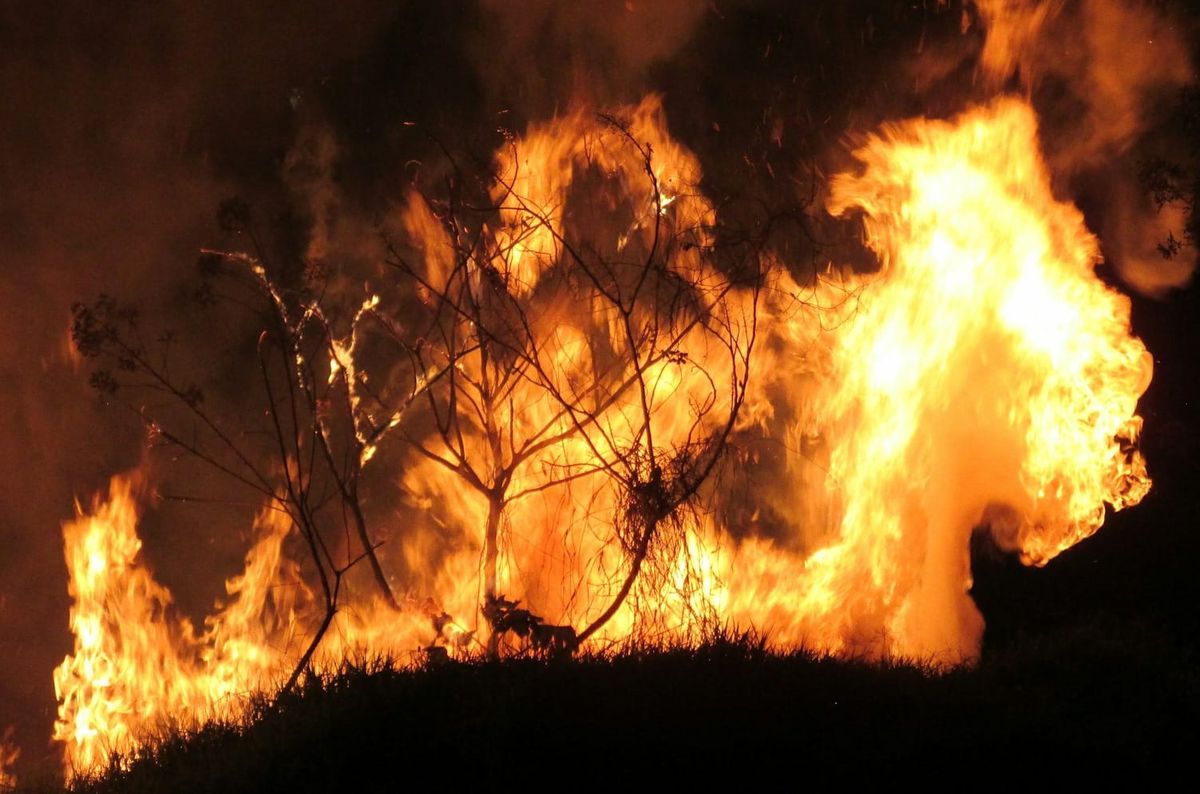
Does money talk? Absolutely. It is fluent in every language. And there has been a whole lot of talkin' going on in recent Walker County elections. What does all that money have to say? Mostly: "I'm on fire."
Three models of campaign funding
Campaigns cost money. Signs, ads, and campaign events cost thousands of dollars for local contests and a lot more for Congressional campaigns.
Where does this money come from? There are three basic funding models, each represented in the recent Republican primaries for Walker County Commissioners Court.
Model 1: Friends and family. You figure this is how Andy Taylor won his election for sheriff back in Mayberry. Family and friends each pitch in a few pennies and it all adds up to a pretty good sum.
Three candidates for Commissioner – Kirk Grisham and Mitchell Ray in Precinct 2 and Brandon Decker in Precinct 4 – used this model, with local donations of (generally) a few hundred dollars each.
Model 2: Self-investment. The quickest way to amass a war chest is with your own money. If you don't invest in yourself, why should anyone else invest in you?
This model was used by Precinct 2 candidate Troy Walker, who spent more money than his two primary opponents combined – $24,000, every penny of it his own.
Model 3: The check is in the mail. There's money in Walker County, but there's a lot more outside of it. Why not harvest some of that?
This model was used by Decker's Precinct 4 opponent Dave Alexander. His donations mostly came from counties miles away.
While the Precinct 4 race is settled, with Decker defeating Alexander, the Precinct 2 race is not. Walker and Ray meet in a May runoff, with more spending in store for each. When the dust settles, total spending for Precinct 2 will likely exceed $50,000. Precinct 4 cost only one-tenth as much.
They raised sick money for that hospital bond
The two hospital bond elections last year, in the spring and fall, also weren't cheap. They cost the hospital district almost $200,000 in election administration costs, while political action committees spent almost $70,000 to persuade voters.
Oddly, the pro-bond forces were different in the two elections. Spring's political action committee was run through TORCH, an advocacy group whose former president, Terry Scoggin, recently became Huntsville Memorial Hospital's CEO. It spent over $52,000, while its successor raised $12,000 in the fall.
These campaigns also used the In the Mail model. While most contributors were local, a little more than half of the money came from out of town, often from businesses or people involved in health care. $3000 from Victoria, another $3000 from Spring. $8,000 from Conroe, $5,000 from Houston, another $5,000 from Corpus Christi. And so on. Sometimes you can guess why a particular out-of-towner would care about Huntsville's hospital, sometimes you can't.
In contrast, the anti-bond PAC, Walker County Liberty PAC, raised $4,510 using the Friends and Family model. Every contribution was local, all but one under $500.
Buying votes would be cheaper: the Congressional primaries
As every Huntsvillan reader knows, twenty-seven people filed to represent Walker County in Congress next year, some in one district (District 8), some in another (District 10). That made for four primaries: two political parties in two districts each.
Each primary was small, averaging 50,000 votes across the entire district, and uncompetitive, with the winner doubling or tripling the runner-up's vote. So you wouldn't think the candidates would spend a lot of money.
You would, of course, be wrong. Over $10,000,000 was spent in total: fifty dollars per voter. It would have been less expensive to just buy votes instead.
Three candidates spent 90% of that money: Republicans Brett Jensen and Jessica Steinmann in District 8 and Chris Gober in District 10. Nearly half of that spending, $4 million, came from the candidates themselves – the Self-Investment model on steroids.
Another $3 million came from political action committees (PACs) based out of state – the In the Mail model, also on steroids. The remainder came from Friends and Family, so to speak. All three funding models were needed to get war chests this big.
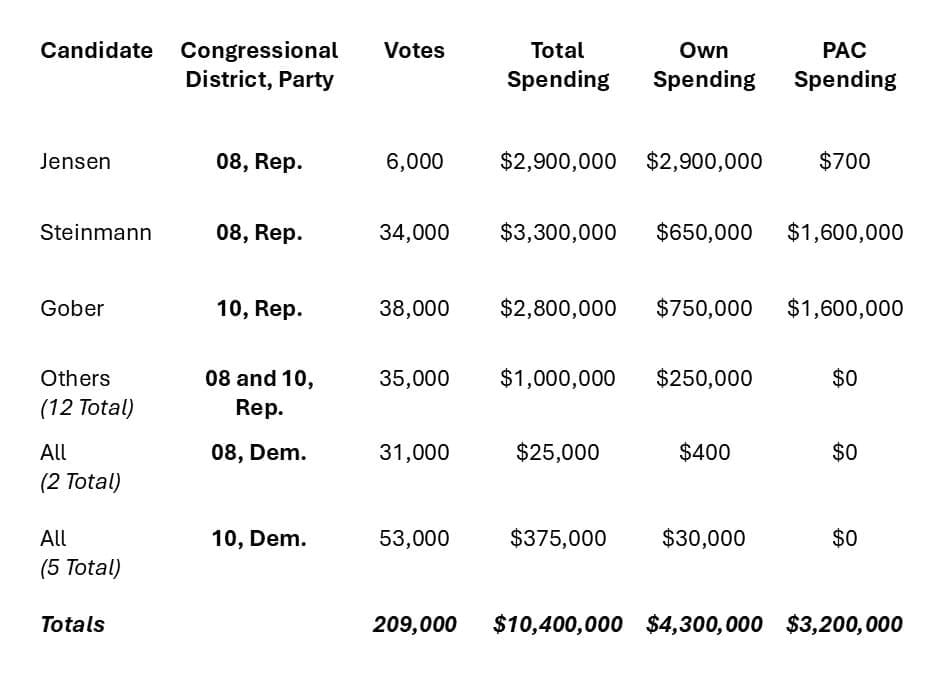
The two biggest political action committees involved industries that are, um, not native to our area: crypto and AI. Gober, a former lawyer for Elon Musk, benefited from almost $750,000 in spending from a tech-connected PAC called American Mission, which "seeks to limit state-level restrictions on AI and data centers."
Steinmann, for her part, benefited from over $750,000 in spending from a PAC, Defend American Jobs, that "is supported by the cryptocurrency industry" – and another half million from American Mission.
Then there is Brett Jensen, who used almost $3 million of his own money to produce ads like this one:
It's clear what Jensen's ad is missing: iambic pentameter, just like your English teacher taught you. If it's good enough for Shakespeare, it's good enough for YouTube. Get with the program, Jensen, and maybe next time you'll receive more than 13% of the vote.
Steinmann and Gober won their primaries and will face off against Democrats Laura Jones and Caitlyn Rourk in the fall.
Those ads were incendiary
Sometimes the logic in a candidate's spending is clear. For example, Huntsvillan Ben Bius loaned his District 10 Congressional campaign over $400,000, but only spent a fraction of that. If he made the runoff, he was ready to open up the throttle. He almost succeeded: Gober received 51% of the vote.
Even with Jensen one could see a certain logic: the guy really loves capitalism, and is willing to prove it by lighting $3 million of his own money on fire.
But for Gober and Steinmann, the logic is far more elusive. The primary election is small, you're trouncing your opponent, the general election is ahead. Why waste all that money?
To put this question in context, the last Conroe ISD school board election had about twice as many voters as Gober's and Steinmann's contests – and was closer too. Imagine spending three million dollars there.
It's not like you couldn't tell how things stood. Polling isn't that costly, and prediction markets considered both contests a done deal, especially in their final weeks. Even if you under-performed those expectations, you could make up for it by spending in the runoff. There is every reason to hold back some of that money, and it's unclear why they didn't.
The Huntsvillan would have asked the campaigns about this directly, but neither Gober's nor Steinmann's websites offered a way for media to contact them. One can only presume getting a Gmail account was beyond their modest resources.
Spending information comes from campaign finance reports from the Walker County Clerk, the Texas Ethics Commission, and the Federal Election Commission, with links at the top of the article. Reports for the County Commission contests omit the last week's worth of spending before the primary was held, which will be reported at a later date.