Rich, with God's grace and mercy
Richard Watkins' memoir reminds you that there was a time when people believed in things.
Some people pride themselves on who they know, how popular they are, who will answer their calls. The Huntsvillan would in a heartbeat – if anyone would actually answer our calls to begin with.
Local community leader and activist Richard Watkins doesn't have this problem. He calls it as he sees it, and if you don't agree, fine. A frequent columnist for the Huntsville Item, Watkins has spoken out on controversial issues both local and national, with a special passion for our schools. "Go along to get along" is not in his repertoire.
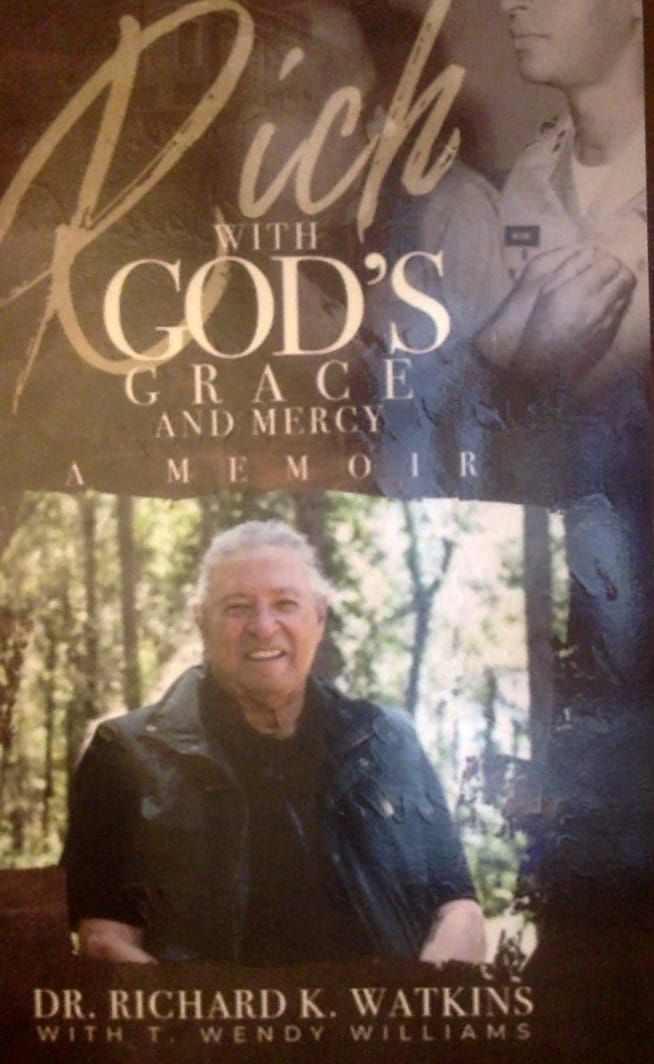
Now Watkins has published a memoir, Rich with God's Grace and Mercy, which covers his years in Huntsville and then some. How bitter is he about the blowback he's received for being outspoken? Judging by the book, not bitter at all. After you've cleared the hurdles he has in his life, harsh words don't have much sting.
So what does he care about, then? Read the book. You may be surprised.
Substance over style
This is a plainspoken book. There are no Hamlet-like soliloquies, no soaring rhetoric, no words to look up in the dictionary.
In this respect it fits cleanly into the literary tradition to which it belongs: African-American autobiography. From Frederick Douglass forward, an earnest, straightforward style has served to highlight the extraordinary events these writers experienced. It serves Watkins well, too. It's easier to see inside a person when fancy verbiage doesn't get in the way.
Straightforward doesn't just describe Watkins' style, but his substance, too. He is brutally honest, sharing uncomfortable truths about his parentage, a business failure, and a lost lawsuit that does not reflect well on him. These are difficult to read not just for what is being shared, but also because we know we wouldn't be so forthcoming ourselves.
This gives him additional credence when he speaks about race. Watkins, who is black, relates several incidents of discrimination. In grade school, his textbooks were hand-me-downs from the white schools. In Vietnam, white helicopter pilots were given missions more readily than he and other black pilots were. Most tellingly, when he became warden at the Holliday unit in town, its picture of Rev. Holliday, the black preacher for whom the unit was named, was not on display, but had been stuffed in a closet. This was in 1997.
Though these incidents are in the past, their everyday nature and Watkins' matter-of-fact style brings to them an immediacy that helps us experience them as he did. This being said, racism is not the central theme of this book. What is?
People and places, not things
The variety of jobs Watkins takes up is astounding – paperboy, helicopter pilot, pharmaceutical sales representative, warden – with several others in-between. Connect the dots and the line zig-zags everywhere. His career had no unifying theme.
That's because the center of his life wasn't work, but place and family. Whenever he zigs away from Huntsville for work – to Houston, or Mineral Wells, or Bonham – he always zags back again. He is clearly fond of his wife Helen and four daughters. One anecdote involving Helen and his military service is simply startling. We all want God looking after us. Helen clearly comes in a close second.
Helen, like Richard, came from an upwardly mobile black family, to which education really mattered. Reconciling that mobility with moving from Houston, where she grew up, to small town Huntsville must have been no small feat. There is a darling story about their courtship involving what amounts to a PowerPoint presentation. Both Watkins now have doctorate degrees.
A true believer
Between his vigorous denunciations of racism, his support of President Obama, and his criticisms of the current war in Iran, you might label Watkins a liberal. In a way, you'd be right. In another way, you couldn't be more wrong.
Watkins' declarations about political topics don't require us to view him through a political lens. There is enough of that going on already, and doing so overlooks the deep conservatism that runs through Watkins' veins.
In the beginning, the terms liberal and conservative had less political meanings. A conservative respected institutions and the wisdom embodied in them. A liberal believed in free inquiry and open discussion to find effective solutions to social problems. Conservative and liberal weren't opposites, but two sides of the coin by which societies best promote human flourishing.
In this sense, Watkins is both liberal and very conservative. He believes in institutions and wants them to work. This thread runs throughout his professional endeavors. A doer, he wants to get things done.
Watkins comes by his school activism naturally, given his lifelong emphasis on education. You think you had difficulties getting that undergraduate degree? Wait until you see what the Watkins' went through. His belief in educational institutions is based on personal experience, and he wants to pay that forward.
The same is true vocationally. When Watkins trains helicopter pilots, he finds a way to streamline the training process. When he first becomes warden at Holliday, he calls in the inspector general to review past incidents of the use of force. When he works for the Huntsville ISD, he obtains funding for a community education program and then helps build the program itself.
In the end, this unapologetic belief in institutions – sometimes against all evidence – is the most striking part of the book, and the man. If you need one reason to read Rich with God’s Grace and Mercy, this is it. Yes, you will learn about Watkins' many unique experiences and discover what it was like growing up in Huntsville before the Civil Rights era. But most of all, you will delve into a life spent believing in things – knowledge, family, place, justice, institutions – and taking the hard actions that belief requires. It's a lesson many of us could stand to learn.
Rich with God's Grace and Mercy is co-authored by T. Wendy Williams, also a Huntsville native, and published by Gallien G5 Publishing. It will soon be available at Mortar & Pestle bookshop downtown, or can be purchased online at all the usual places. Mortar & Pestle is hosting a book signing on Sunday, Oct. 18, at 2:30 pm.