Local schools get grades of their own
The tables have turned.

In our public schools, it's not just student performance that gets measured. The performance of schools and districts gets measured too, by the state. It stores everything on computer and can quickly pull up lots of detail – test scores, staffing, funding, even what the students do after graduating.
Schools' biggest report card is called the Texas Academic Performance Report, or TAPR. It contains all of this information. It's like oversharing, done by a government agency instead of your friend.
The most recent TAPR was released in December, after which the school districts hold a public hearing at which anyone can speak. The Huntsvillan went through all of this stuff so you don't have to – reviewing the TAPR and then, through the magic of YouTube, attending the public hearings.
What did we learn? Much more than we expected to. This article focuses on the TAPR, and the next, coming soon, on those hearings.
Like a TikTok video, only twenty pages long and full of numbers
Each school's TAPR is over twenty pages long. There's numbers everywhere. But they do tell a story, in their own dry way. These stories are different, depending on the school.
That really comes through in examining Walker County's two public high schools – Huntsville High and New Waverly High – along with one to our south, College Park High in The Woodlands. You couldn't find three schools that are more different.
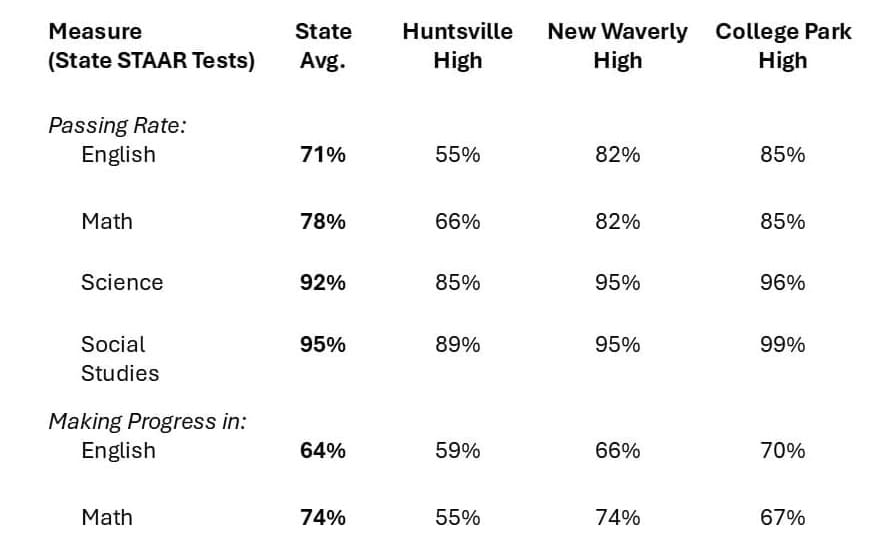
First up is performance on the "STAAR" end of course exams all public high schoolers must take. Huntsville High is well below the state average in terms of passing and making progress, while New Waverly and College Park are a little above average in both.
This holds true across the board and is not limited to specific subjects. Whatever New Waverly and College Park are doing right – and Huntsville is doing wrong – has to do with the school, not particular teachers.
That's while you're in school. What happens afterwards? Do the students graduate? Are they ready for the next chapter in their lives? The TAPR is all over this.
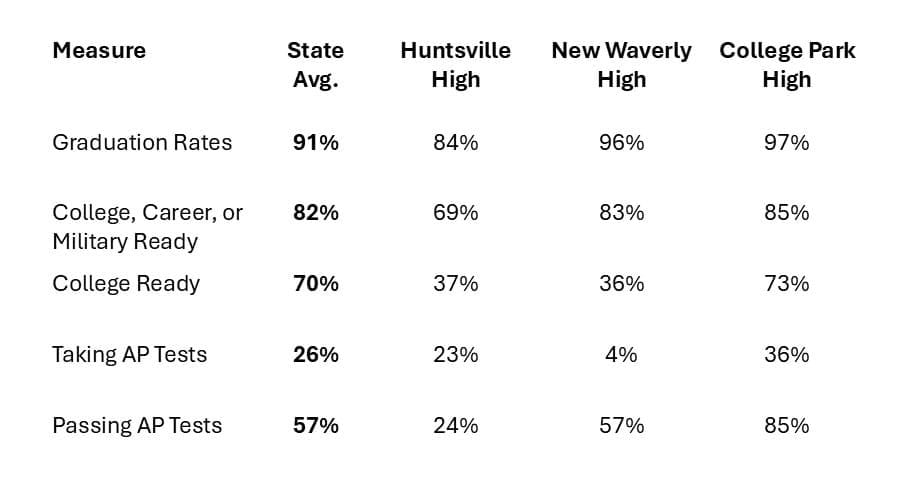
In terms of graduation, the difference between Huntsville High and the other two schools is even more striking. The former is well below the state average and the others well above it. Whatever breakdown there is at Huntsville High affects graduation too.
And the next chapter in their lives? This is measured by college, career, or military readiness. Again Huntsville lags behind the state average, while New Waverly and College Park are a little bit above it.
This pattern ends once you look at college readiness. In Huntsville and New Waverly, it is strikingly low. Only about one-third of graduates are college-ready, well below College Park and the state average.
One way to get ready for college is to take Advanced Placement (AP) courses in high school. Pass the AP test afterwards and you get college credit. Only College Park really leans into this.
A picture begins to emerge. College Park, full of professional parents with big aspirations for their children, really emphasizes college preparation. But if your child doesn't want to go to college, it's nothing special. They would do just as well at New Waverly.
New Waverly High is too small to focus on college like College Park can. College Park has almost as many staff as New Waverly has students. (Yes, this is also in the TAPR.) Instead, New Waverly focuses on getting the basic stuff right – passing the STAAR tests, graduating, being ready for life afterwards, even if it doesn't involve college.
How do they do it?
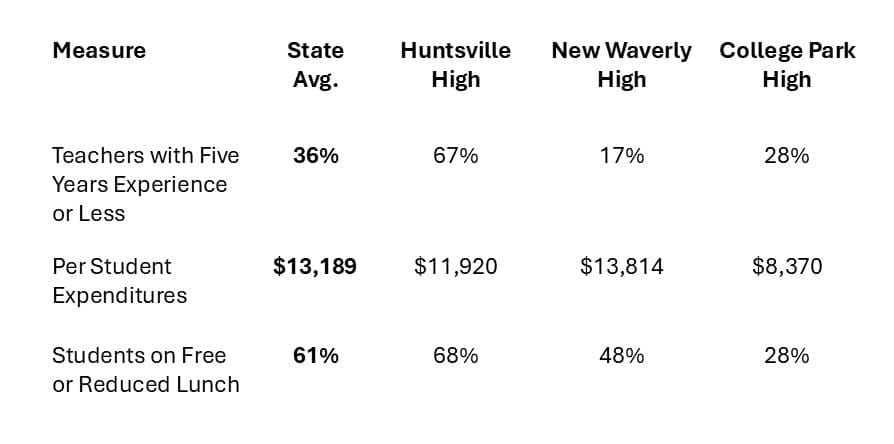
The last part of the TAPR looks under the hood: staffing, funding, student characteristics. Across these three schools, these are really different.
In terms of students, College Park has the wealthiest and Huntsville High the poorest. Two-thirds of its students qualify for free or reduced lunch. Federal funding follows student poverty, and that holds true here too – College Park spends the least per student by far.
Despite that, College Park's teachers are relatively experienced, New Waverly's even more so. On the other hand, a whopping two-thirds of Huntsville High's teachers have five years of experience or less, a fact emphasized in The Huntsvillan last fall. It's hard to have effective instruction with so much teacher turnover.
Now the picture of these schools emerges further. College Park, with its large size and wealthy students, focuses like a laser on college preparation. New Waverly, smaller and poorer, delivers on the basics with a dedicated teaching staff that sticks around year after year.
Huntsville, in contrast, struggles on all dimensions – test scores, graduation, post-secondary readiness. This is what's going to happen if you can't keep teachers around. This and other issues will be sitting on the desk when Huntsville ISD's new superintendent starts work this summer.
This is the first part of a two part series. The second article compares the February meetings of each of these three districts' school boards, when the aforementioned public hearings are generally held. These were even more varied than the TAPR itself. That story comes next week.
To look up the TAPR for any Texas public school, go here.